

The Blue Ocean Shift: Making Competition Irrelevant
19/01/2026 • 00:06:00
Introduction:
In traditional strategic thinking, the market is a Red Ocean: a defined space where boundaries are known and "sharks" (competitors) fight for a bigger slice of existing demand. As the water turns bloody with price wars and margin compression, growth stalls.
Blue Ocean Strategy challenges this zero-sum game. It posits that high growth is achieved by creating "Value Innovation"—simultaneously increasing buyer value while lowering costs—to unlock entirely new market spaces where the competition simply doesn't exist yet.
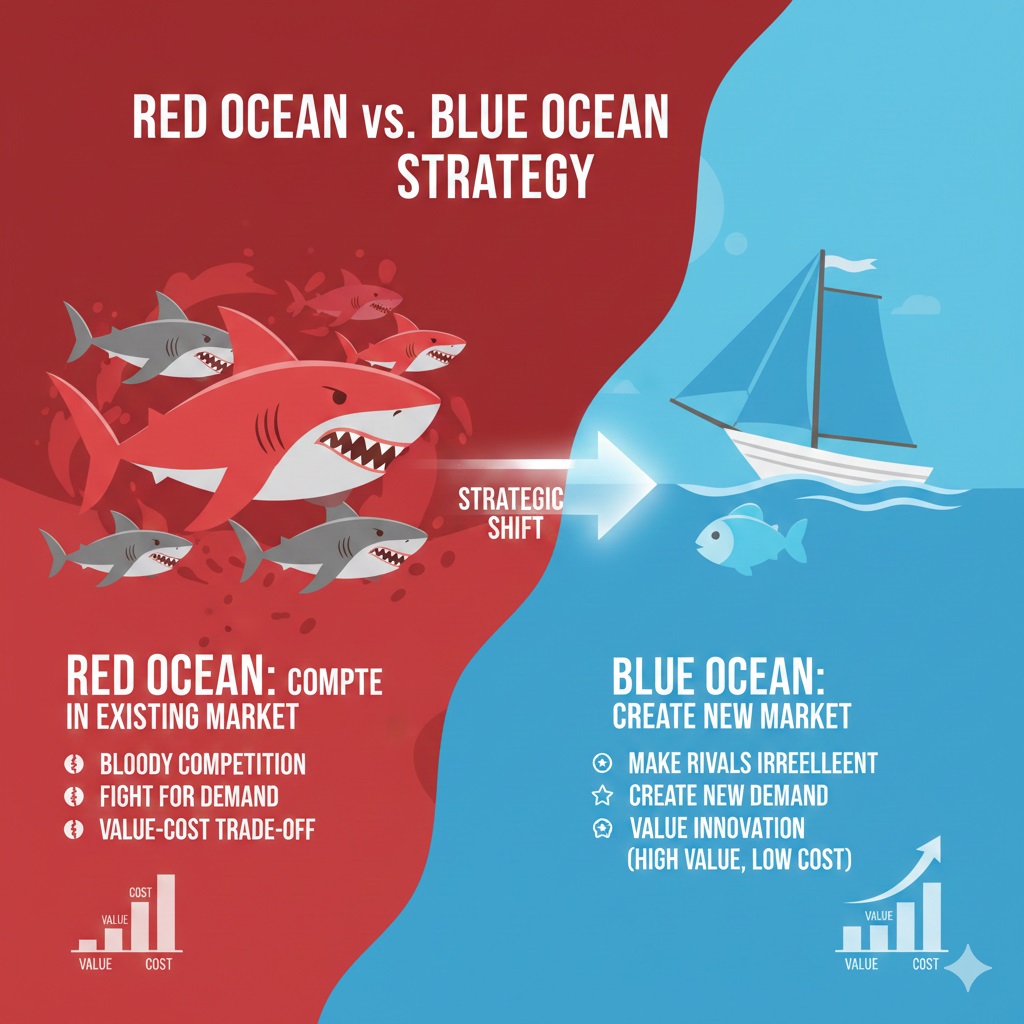
🚀 How to Use the Framework
To successfully navigate away from the red sharks, organizations utilize the ERRC Grid (Eliminate-Reduce-Raise-Create). This allows you to break the value-cost trade-off:
- Analyze the Strategy Canvas: Map out the "Value Curve" of your industry to see exactly where competitors are over-investing in low-impact features.
- Identify Non-Customers: Look beyond your current user base to the "refusers" and "unexplored" segments who find the current industry offerings too complex or expensive.
- Execute Value Innovation: Align your entire system of utility, price, and cost to create a leap in value.
The Four Action Pillars
The core of the strategy is built on four distinct actions that force you to challenge industry logic:
- Eliminate: Which factors that the industry has long competed on should be eliminated? (e.g., Cirque du Soleil eliminated animal acts and star performers).
- Reduce: Which factors should be reduced well below the industry’s standard? This prevents "over-engineering" and lowers the cost structure.
- Raise: Which factors should be raised well above the industry’s standard? This ensures you are solving a specific pain point better than anyone else.
- Create: Which factors should be created that the industry has never offered? This is the birth of the "Blue Ocean."
The Three Tiers of Non-Customers
Blue Ocean thinkers don't just fight for existing customers; they look at the "Three Tiers" to expand the market:
- First Tier: "Soon-to-be" non-customers who are on the edge of your market, waiting to jump ship as soon as an alternative appears.
- Second Tier: "Refusing" non-customers who consciously choose against your industry because the offerings don't meet their needs.
- Third Tier: "Unexplored" non-customers who are in markets far away and have never thought of your offering as an option.
Why is a Blue Ocean Shift Useful?
This framework solves the "commoditization trap" that kills modern businesses:
- Escaping Price Wars – By making the competition irrelevant, you regain pricing power. You are no longer compared apples-to-apples with "Red Sharks."
- Simultaneous Differentiation & Low Cost – Traditional strategy says you must choose one. Blue Ocean proves that by eliminating wasteful features, you can be both better and more efficient.
- Market Creation – Instead of fighting for a share of a shrinking pie, you create a new, larger pie.
- Sustainable Brand Moats – Blue Ocean moves create powerful cognitive barriers. When a brand defines a new category, it becomes synonymous with that category (e.g., Netflix, Uber, or Airbnb).
- Internal Alignment – The framework provides a clear visual language (The Strategy Canvas) that aligns the entire organization—from HR to Engineering—under a single strategic vision.